
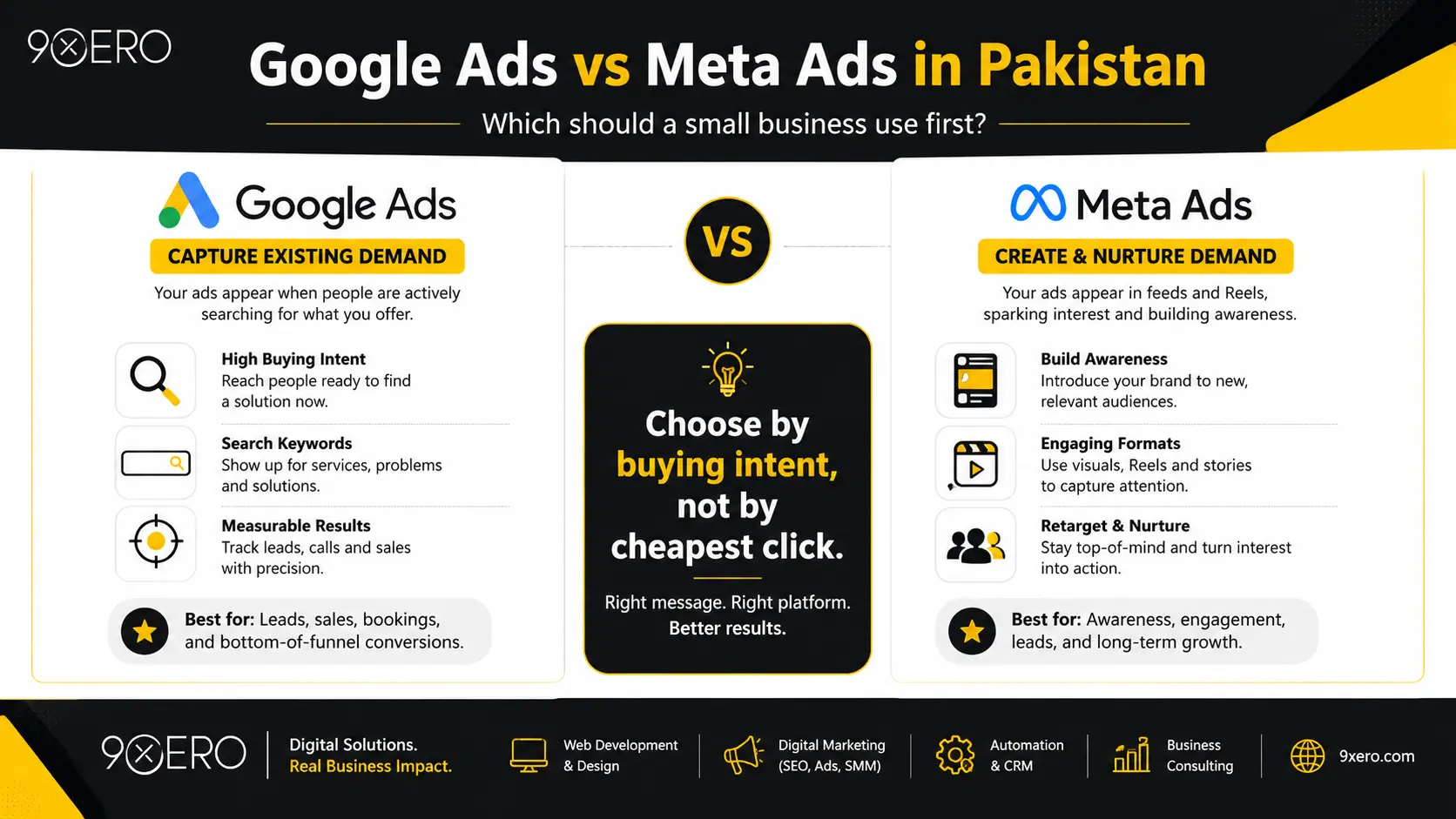
If your business has a limited advertising budget, choosing between Google Ads and Meta Ads is not a small decision. The wrong question is usually, “Which platform has cheaper clicks?” The better question is: “Where is my customer in the buying process, and which platform puts me in front of them at that moment?”
For most Pakistani small businesses, the simple answer is this:
- Start with Google Ads when people already search for the service or product you sell and you need to capture active demand.
- Start with Meta Ads when your offer needs to be seen, demonstrated, explained, or repeatedly placed in front of the right audience before they act.
- Use both when you need Meta to create or nurture demand and Google to capture the searches that follow.
The winning platform is not the one with the cheapest click. It is the one that produces the best qualified customer economics.
Google Ads vs Meta Ads: The Core Difference
Google Ads and Meta Ads can both generate leads and sales, but they often meet the customer at different moments.
Google Search is fundamentally intent-led. A person searches for something such as “accounting firm Islamabad,” “office renovation company Lahore,” “dental clinic near me,” or “CRM software Pakistan.” The search itself tells you that the need already exists.
Meta advertising works across environments such as Facebook and Instagram feeds, Stories, and Reels. People are not necessarily searching for your service when your ad appears. Your creative has to earn attention, communicate value, and make the viewer interested enough to take the next step.
That distinction matters because it changes how you judge performance. Google may produce fewer but more intent-rich visits. Meta may produce cheaper reach or leads but require stronger qualification and follow-up. Neither outcome is automatically better.
Quick Decision Table
Choose Google Ads first when:
- Customers actively search for your service.
- You sell a high-intent local or professional service.
- Calls, enquiries, consultations, bookings, or quote requests matter more than broad awareness.
- Your offer can be explained clearly on a landing page.
- You can track conversions and qualified outcomes.
Choose Meta Ads first when:
- Your offer is visual or benefits from demonstration.
- The customer may not know they need the product yet.
- You need to build awareness or launch something new.
- Video, Reels, carousels, testimonials, before-and-after content, or creator-style content can sell the idea.
- Retargeting and repeated exposure are important to the buying cycle.
Use both when:
- Meta creates interest and Google captures later searches.
- You have enough budget to give each platform a real test.
- Your CRM and tracking can identify source, lead quality, appointments, and sales.
When Google Ads Usually Makes More Sense
1. The buyer is already looking for the solution
Google becomes especially attractive when demand already exists in search. Service businesses are the clearest example. Someone searching for a specific accountant, lawyer, dental treatment, software provider, contractor, training course, or marketing service has already moved beyond passive awareness.
Your job is to match that intent with the right keyword, ad message, landing page, proof, and call to action.
2. You need leads, calls, bookings, or enquiries now
Google Ads includes campaign objectives for Leads and Sales. That does not guarantee results, but the platform is structurally well suited to capturing existing intent. If you need an enquiry from someone already researching providers, Search is often the most logical first test.
3. Your service is difficult to “discover” casually
Some purchases do not perform naturally in a social feed. A business owner may not stop scrolling because they suddenly want payroll software, an ERP implementation, an immigration consultant, or a specialist B2B service. But when that need becomes urgent, they search.
That is exactly where Google can be strongest.
When Meta Ads Usually Makes More Sense
1. Your offer is visual
Meta gives businesses a much richer creative canvas. Product demonstrations, property walkthroughs, fashion, food, education, events, beauty, fitness, hospitality, and other visually driven categories can benefit from video, carousels, Stories, and Reels.
Meta’s current Reels guidance emphasises mobile-native 9:16 creative, audio, and keeping important messages inside safe zones. This is a useful reminder that Meta performance is often a creative problem before it is a targeting problem.
2. You need to create demand, not only capture it
A new product, unfamiliar service, new restaurant, training programme, or differentiated offer may not have much direct search demand yet. Meta lets you reach relevant audiences before they begin actively looking for a provider.
Good Meta advertising does not simply “interrupt” people. It gives them a reason to care.
3. Your sales cycle needs repeated exposure
People rarely buy everything after one interaction. Meta can play a strong role in retargeting site visitors, video viewers, engaged audiences, and existing contacts where appropriate. That makes it useful for staying visible while a prospect is still deciding.
Pakistan Has Enough Digital Scale for Both Platforms
Pakistan’s digital audience is large enough that the platform decision should be made on business fit rather than a belief that one channel has no reach.
DataReportal’s Digital 2026 Pakistan report states that the country had 117 million internet users at the end of 2025. It also reports 79.9 million social-media user identities, with Meta’s advertising tools indicating potential reach of 52.9 million on Facebook and 22.4 million on Instagram in late 2025.
Those figures do not mean every person is an active customer, and DataReportal explicitly warns against treating advertising reach as the same thing as active-user counts. The practical point is simpler: Meta has substantial advertising reach in Pakistan, while Google captures a very different behaviour—active search intent.
Do Not Compare the Platforms by CPC Alone
This is where many ad-budget decisions go wrong.
Suppose Meta delivers cheaper clicks than Google. That sounds good until the Meta leads contain more casual enquiries, poor-fit prospects, job seekers, or people who never answer the phone. Now suppose Google clicks cost more but produce a higher percentage of qualified consultations. The “expensive” platform may actually be cheaper where it matters.
Instead of comparing only CPC, measure:
- Cost per lead
- Cost per qualified lead
- Qualification rate
- Cost per booked meeting or appointment
- Opportunity rate
- Customer acquisition cost
- Revenue or gross profit generated
A useful formula is:
Cost per qualified lead = Total ad spend ÷ Number of qualified leads
And for sales-led businesses:
Customer acquisition cost = Total advertising and acquisition cost ÷ New customers acquired
The closer your measurement gets to revenue, the more useful your channel decision becomes.
Which Platform Should Different Types of Businesses Start With?
Local and professional services
Examples: clinics, legal services, accountants, home services, repair services, consultants, B2B specialists.
Start by checking search demand. If prospects clearly search for the service, Google Search is usually the cleaner first test. Meta can then support awareness and retargeting.
Ecommerce and visual consumer products
Examples: fashion, beauty, food products, home décor, lifestyle products.
Meta may deserve the first test because creative can create desire and product discovery. Google can become equally important where Shopping or strong product search demand exists. The answer depends on the product, margin, search volume, feed quality, and creative strength.
Real estate and education
Both platforms can matter. Meta can introduce a project, development, course, or programme through strong visual storytelling. Google can capture people actively searching for specific locations, projects, courses, fees, or providers.
B2B software and complex services
Google is often the more logical first channel when prospects search for the problem or solution category. Meta can still be valuable for retargeting, founder-led content, thought leadership, and demand creation—but the lead-quality bar should stay high.
The Best Strategy Is Often a Joined-Up Funnel
Treating Google and Meta as enemies is usually unnecessary. They can do different jobs inside the same acquisition system.
A practical funnel might look like this:
- Meta video or carousel introduces the offer.
- Interested prospects visit the site or engage with the content.
- Retargeting reinforces proof, testimonials, benefits, or urgency.
- Some prospects later search the brand, category, problem, or competitor on Google.
- Google Search captures that active demand.
- CRM records the original source, current source, lead quality, meeting, opportunity, and sale.
The important part is not “being everywhere.” It is knowing what each channel is supposed to accomplish.
Fix Tracking Before You Scale Either Platform
Paid advertising becomes expensive when the platforms optimise toward the wrong signal.
At minimum, a lead-generation business should know:
- Which campaign generated the lead.
- Whether the lead was qualified.
- Whether contact was made.
- Whether a meeting was booked.
- Whether an opportunity was created.
- Whether the deal closed.
For Google, conversion actions should reflect meaningful business outcomes. For Meta, pixel and conversion-event quality matter, and many businesses also benefit from server-side or CRM feedback where appropriate.
If your marketing team celebrates 100 form submissions while sales says 80 were useless, you do not have a lead-generation success. You have a measurement problem.
This is where CRM discipline matters. Advertising should connect to the pipeline, not stop at the form.
Contextual CTA
If your current Google or Meta campaigns report plenty of leads but sales quality is unclear, 9Xero can review the ad account, landing page, conversion setup, and CRM handoff as one system rather than treating each piece separately.
A Practical 30-Day Testing Framework
Week 1 — Measurement and offer
Before increasing spend:
- Confirm the primary conversion.
- Define a qualified lead.
- Check landing-page message and CTA.
- Make sure source tracking and CRM fields exist.
- Prepare creative or keyword structure for the platform being tested.
Week 2 — Launch controlled tests
Do not scatter a small budget across too many campaigns. Give the strongest hypothesis a fair test. On Google, that usually means controlled high-intent keyword coverage. On Meta, it means a small number of strong creative angles rather than dozens of weak variations.
Week 3 — Analyse quality, not vanity metrics
Review search terms, lead quality, audience response, creative performance, qualification, contact rate, and appointment rate. Cut obvious waste, but do not rewrite the strategy every 24 hours.
Week 4 — Compare economics
Ask:
- Which platform generated the most qualified opportunities?
- Which produced the best cost per qualified lead?
- Which created appointments or revenue?
- Which needs a better landing page, offer, creative, or follow-up process before you judge it?
Then reallocate budget based on evidence.
Common Mistakes Pakistani SMEs Should Avoid
- Choosing Meta only because the clicks appear cheaper.
- Choosing Google without checking actual search volume and keyword intent.
- Sending all paid traffic to a generic homepage.
- Running lead forms without a qualification process.
- Treating every form submission as an equal conversion.
- Ignoring mobile landing-page experience.
- Running Meta without enough creative variation.
- Running Google without search-term reviews and negative keywords.
- Failing to connect ad data with CRM outcomes.
- Scaling spend before proving lead quality.
Final Recommendation
If your customers already search for exactly what you sell, test Google Ads first.
If your offer needs visual discovery, education, storytelling, or repeated exposure, test Meta Ads first.
If both conditions are true, use both—but give them different jobs. Meta can create and nurture attention. Google can capture active demand. Your CRM should tell you which channel creates qualified opportunities and customers.
Do not declare a winner based on CPC. Judge the platforms by qualified pipeline and customer economics.