

AI automation can save a small business considerable manual work, but buying more AI tools is not the same thing as automating a business.
For many growing companies in Pakistan, the real problem is much less glamorous: leads arrive through different channels, somebody copies them into a spreadsheet, follow-ups depend on memory, customer messages sit across several inboxes, reports are assembled manually, and the owner becomes the person connecting everything together.
That is exactly where automation can become valuable.
The right starting question in 2026 is therefore not “Which AI tool should we buy?” It is: Which repetitive business process is currently costing us the most time, leads or visibility?
That distinction matters because the best automation projects normally begin with a business bottleneck—not with AI.
Why automation matters for Pakistani SMEs now
Small and medium enterprises are not a niche segment of Pakistan’s economy. State Bank of Pakistan material citing SMEDA estimates says the country has more than 5.2 million SMEs, which contribute around 40% of GDP, 25% of exports and 78% of non-agricultural employment.
The regulatory definition has also recently been updated. As of July 2026, SBP defines a small enterprise as one with annual sales above PKR 30 million and up to PKR 400 million, while a medium enterprise can have annual sales above PKR 400 million and up to PKR 2 billion.
Pakistan is simultaneously pushing further into AI. The National Artificial Intelligence Policy was approved in July 2025, while the Ministry of IT said in April 2026 that AI had become a national priority sector and described plans to upskill one million non-IT professionals.
For an SME owner, however, national AI ambition only matters when it translates into a better business process.
That means fewer enquiries falling through the cracks, less duplicate data entry, faster follow-up, better reporting and more time spent on work that actually requires a person.
What is AI business automation?
Business automation means using software to perform defined tasks or move information between systems with less manual intervention.
AI automation adds models capable of working with less structured information—for example, interpreting a customer message, summarising a conversation, classifying an enquiry or generating a response for review.
The two should not be confused.
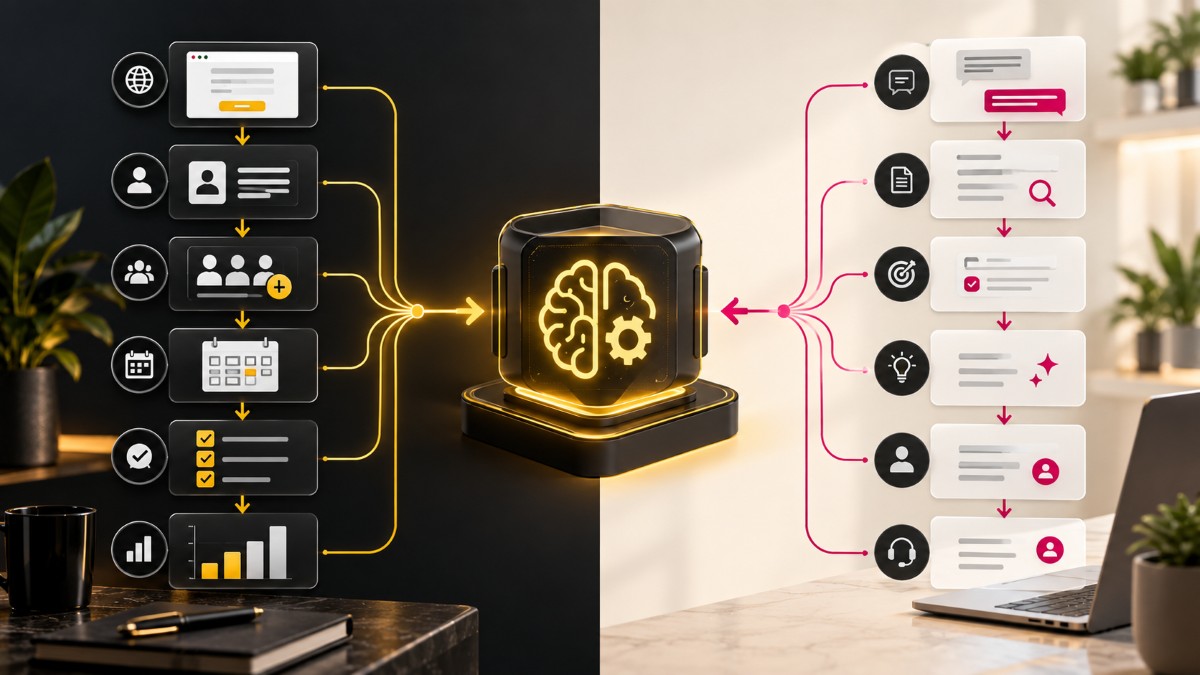
Rule-Based Workflow
This workflow follows clear, predictable rules. It does not necessarily need AI and can be handled reliably with traditional automation.
Interpretation-Based Workflow
AI becomes useful here because the workflow requires interpretation, classification and contextual understanding before the next action.
Good automation uses the simplest reliable technology for each step.
What should a small business automate first?
For most service and sales-led SMEs, the priority order should be:
Why this order? Because the first automations should sit close to revenue or expensive repetitive work.
Automating a low-value administrative task can save a few minutes. Automating a broken enquiry-to-follow-up process can protect opportunities the business is already paying to generate.
1. Start with lead capture
Consider a business generating enquiries from its website, Meta campaigns, Google Ads, WhatsApp and social media.
Without a central process, employees may record some enquiries in spreadsheets, leave others inside WhatsApp and remember the rest through notifications.
The first automation should establish one source of truth.
A better flow is: Lead source → CRM → owner assigned → source recorded → next action created.
The CRM does not need to be complicated. What matters is that every legitimate enquiry reaches the same pipeline with enough information for somebody to act.
Useful fields could include name, phone and email, lead source, service requested, campaign or source information, lead status, assigned person, last contact, next follow-up and outcome.
Once that foundation exists, more advanced automation becomes much safer.
2. Automate follow-up before chasing more leads
Businesses often focus on generating more enquiries before fixing what happens to existing ones. That is backwards.
If a company is already paying for advertising or generating organic enquiries, the first operational question should be: What happens during the first few minutes, hours and days after someone contacts us?
A basic follow-up workflow could acknowledge the enquiry immediately, assign it to the appropriate salesperson, create a call or follow-up task, alert a manager if nobody takes ownership, send an approved follow-up after a defined period, and stop automated sales messages once the lead replies or changes status.
This is where CRM automation becomes commercially useful: not as a database, but as a system that makes the next action difficult to forget.
3. Automate appointment scheduling and reminders
Scheduling is another relatively safe place to begin.
Instead of repeated messages about availability, businesses can connect enquiry qualification, calendars and reminders.
↓
Booking Link
↓
Appointment Confirmed
↓
CRM Updated
↓
Reminders Sent
↓
Salesperson Notified
After the meeting, the workflow can create the next action rather than leaving the outcome buried in someone’s calendar.
This is particularly relevant for consultancies, agencies, property businesses, clinics, education providers and other appointment-led companies.
4. Automate repetitive customer questions—but preserve escalation
Customer communication is one of the areas where AI can help, but it is also where poor implementation becomes painfully visible.
Start with high-volume, low-risk questions such as opening hours, appointment availability, basic service information, order-status requests, document requirements, initial lead qualification and frequently asked questions.
The system should also know when to stop. Pricing exceptions, complaints, sensitive customer issues, complex negotiations and unusual cases often require human judgment.
A sensible architecture therefore looks like: Customer message → classify request → answer approved routine query OR route to person → preserve conversation context.
The objective is not to hide humans from customers. It is to stop employees repeatedly answering questions that a reliable system can handle.
5. Automate internal handoffs
Some of the most valuable automation is invisible to the customer.
Consider what happens after a salesperson closes a deal. Does somebody manually tell accounts? Does a project manager need to chase the salesperson for the brief? Does the operations team create a folder, task and client record separately?
A connected workflow can turn a status change into a controlled handoff.
↓
Notify Accounts
↓
Create Onboarding Task
↓
Create Project Record
↓
Request Required Information
↓
Assign Delivery Owner
This is ordinary workflow automation, but it can remove the small gaps where operational problems accumulate.
6. Automate recurring reports
If a manager spends every Monday collecting numbers from multiple systems and copying them into another spreadsheet, that process is an obvious candidate.
A reporting workflow can pull defined metrics into a dashboard or scheduled report.
The key word is defined. Automating bad metrics simply produces bad reporting faster.
Before building the workflow, decide which decisions the report will support, which numbers actually matter, where the source data lives, who owns data accuracy, and how frequently the business needs the report.
Only then automate it.
7. Add AI where interpretation creates value
Once the underlying workflow is stable, AI can become much more useful.
Potential applications include lead classification, conversation summaries, draft responses, information extraction and internal knowledge assistance.
The important principle is simple: AI should solve a defined problem inside the process. It should not become the process.
AI automation versus normal automation: which do you need?
| Business Task | Traditional Automation | AI |
|---|---|---|
| Create CRM contact from form | Yes | Usually not needed |
| Assign lead by location/service | Yes | Sometimes useful |
| Send appointment reminder | Yes | Not required |
| Update status after defined trigger | Yes | Not required |
| Understand an unstructured enquiry | Limited | Useful |
| Summarise a long conversation | No | Useful |
| Draft contextual response | Limited | Useful |
| Calculate predefined KPI | Yes | Usually not needed |
| Interpret documents | Limited | Often useful |
| Approve high-risk business decision | Human required | |
A practical automation-priority formula
Before automating a workflow, score it from 1 to 5 across five factors:
A practical automation-priority formula
Before automating a workflow, score it from 1 to 5 across five factors:
Frequency
How often does this task happen?
Time
How much employee time does it consume?
Revenue
Does failure affect leads, sales or retention?
Error Risk
How costly are mistakes or missed steps?
Standardisation
Can the process be described with clear rules?
0
/25
Low priority
Review
Strong candidate
Automate first
A repetitive, time-consuming, revenue-adjacent and well-defined task is normally a stronger automation candidate than a rare process requiring subjective judgment.
This is also why lead follow-up often beats “AI content generation” as the first serious automation project for a sales-led SME. One sits directly inside the revenue process. The other may simply produce more content.
What should you not automate first?
Avoid beginning with a process when the process itself is unclear, the volume is tiny, exceptions dominate the process, the data is unreliable, or the consequence of an incorrect decision is high.
Financial approvals, legal decisions, sensitive HR matters and other high-impact processes should retain appropriate human controls.
How to automate a small business step by step
Step 1: Map one process.
Choose one workflow and document what happens today. Do not begin by buying software.
Step 2: Find the bottleneck.
Look for delays, duplicate entry, missed follow-ups, unnecessary approvals and repeated manual work.
Step 3: Define the desired outcome.
“Use AI” is not an outcome. “Every website enquiry should reach the CRM, receive an acknowledgement and have an assigned owner” is.
Step 4: Standardise the workflow.
Define statuses, owners, rules and exceptions.
Step 5: Connect the systems.
Integrate the CRM, forms, calendars, messaging, advertising or other relevant platforms.
Step 6: Automate the predictable path.
Begin with deterministic rules.
Step 7: Introduce AI selectively.
Add AI where understanding text, classifying information, summarising or drafting genuinely improves the process.
Step 8: Keep human checkpoints.
Define when a person must approve, intervene or take ownership.
Step 9: Measure the result.
Useful measures might include first-response time, percentage of leads assigned, overdue follow-ups, appointments booked, manual hours spent, process error rate and lead-to-opportunity conversion.
Step 10: Improve before expanding.
Do not automate ten broken workflows simultaneously. Make one meaningful process reliable, measure it, then move to the next.

A simple example: from ad click to sales follow-up
Imagine an Islamabad service business running Meta and Google campaigns.
The company generates enquiries, but salespeople manually copy details, and management cannot easily tell which campaigns produced qualified opportunities.
A better architecture could be:
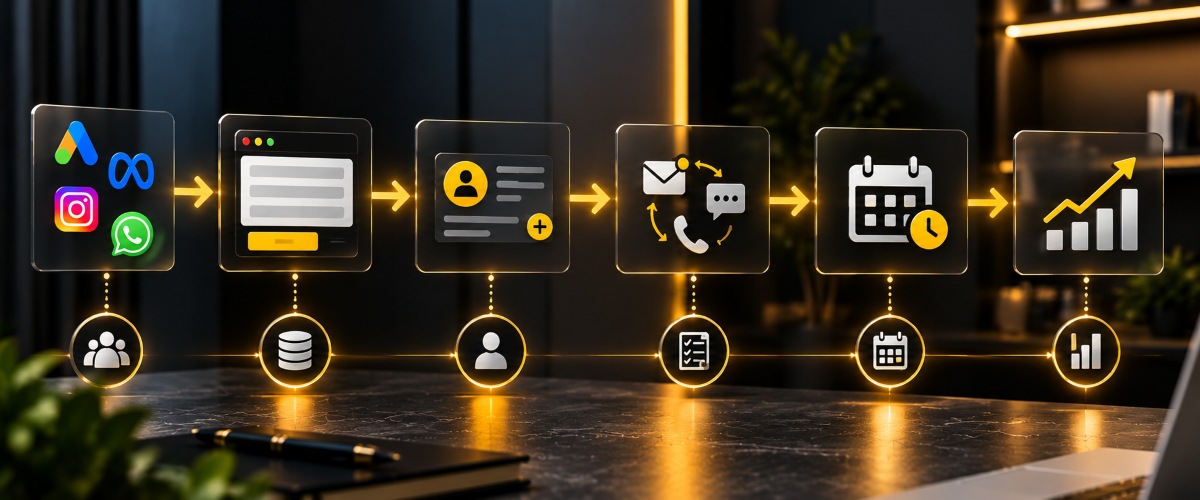
AI could subsequently help classify enquiries or summarise conversations, but the business value begins with the connected process.
That is the difference between adding an AI tool and building an operating system around the customer journey.
How much automation does a small business actually need?
Usually less than vendors suggest.
The objective should not be maximum automation. It should be the minimum reliable automation required to remove the bottleneck.
A five-person business does not need an enterprise transformation programme simply because AI is fashionable. It may need a properly configured CRM, connected lead sources, disciplined statuses, automated reminders and two or three well-designed workflows.
As the business grows, that foundation can support more sophisticated systems.
Pakistan’s AI opportunity is real—but implementation will decide the value
Pakistan is making an institutional push toward AI, while millions of SMEs continue to form a major part of the country’s economic base.
For individual businesses, however, competitive advantage will not come from announcing that they “use AI.”
It will come from operational improvements customers can actually experience: faster responses, fewer missed follow-ups, cleaner handoffs, better information and more consistent service.
That is where small-business automation should start.
And if your first automation proposal requires seventeen platforms, six autonomous agents and a diagram that resembles Karachi traffic at 6pm, the process probably needs simplifying before it needs automating.